
Observed Error Monitoring as an Index of Theory of Mind
Overview and Theoretical Framework
This study examined the relationship between Theory of Mind (ToM) and observed error monitoring (OEM), two cognitive processes believed to jointly support social learning.
Thriving socially requires us to understand and learn from one another. One of the ways that we learn from others is by watching them make errors. Being able to identify others’ errors is called observed error monitoring (OEM).
To recognize that another person made an error, we have to first understand their goals and motivations. This ability to mentalize what another is thinking is called Theory of Mind (ToM) and can be classified within the wider scope of social cognition (SC), which refers to a collection of neurocognitive processes involving the identification, comprehension, and utilization of social cues within one's own actions and behavior.
ToM impairments span across several major mental disorders such as schizophrenia , autism spectrum disorder, and social anxiety disorder. SC is a relatively new field of research that currently lacks the same level of validation and reliable empirical evidence as non-social neurocognitive constructs.
While there are decades of supporting research on how ToM and OEM might be related to each other through social learning, validating OEM as an index of ToM performance in a healthy sample still remains to be attempted. Favorable outcomes would further merit replication and using ToM impaired samples (e.g., Autists).
Study Objectives and Hypotheses
- The primary aim of the study was to evaluate whether OEM could serve as a neural index of ToM performance. Specifically, the study tested whether ToM measures would predict amplitudes of two OEM-related event-related potentials: the observed error-related negativity (oERN) and the observed feedback-related negativity (oFRN). Additional hypotheses examined whether these relationships differed across social contexts, including neutral, competitive, and cooperative conditions.
Key Findings
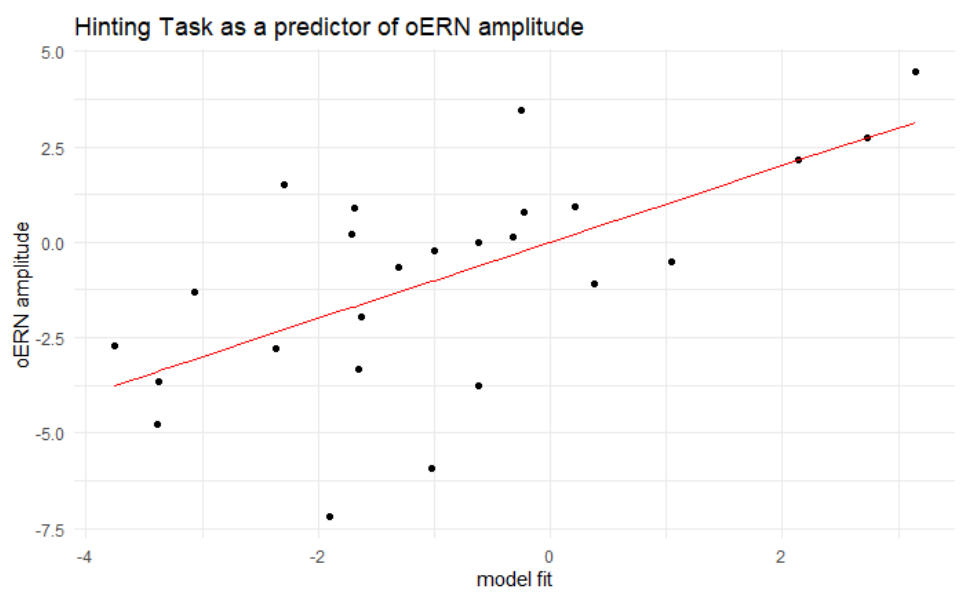
Initial analyses revealed a strong negative relationship between HT scores and oERN amplitudes that did not reach statistical significance. However, after accounting for combined household income as a post-hoc covariate, HT scores significantly and negatively predicted oERN amplitudes with a medium effect size. No significant relationships were found between ToM measures and oFRN amplitudes, suggesting limited sensitivity of the oFRN to ToM-related processes in low-motivation social contexts.
Role of Social Context and Reward Sensitivity
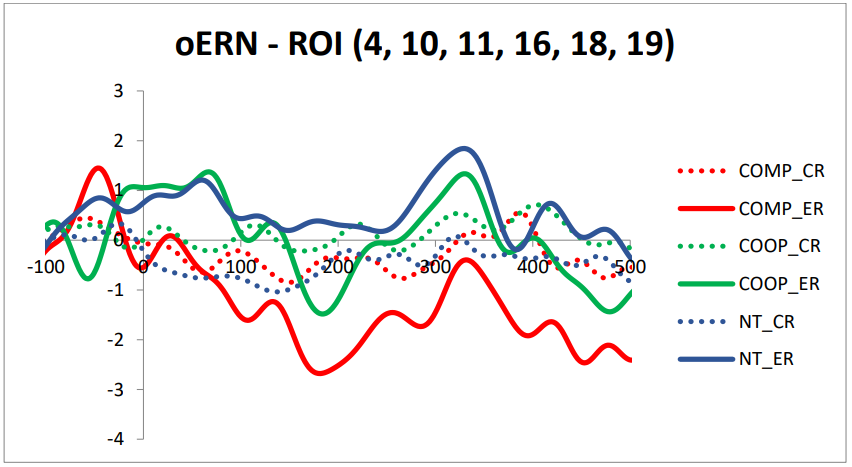
Reaction times were faster in incentivized conditions relative to the neutral condition, indicating successful reward manipulation. oERN amplitudes were significantly more negative in the competitive condition compared to the neutral condition, but did not differ between competitive and cooperative contexts. These findings suggest that the oERN may primarily encode the absolute relevance of observed errors to personal outcomes rather than finer distinctions between cooperative and competitive social structures.
Exploratory Analyses
Exploratory analyses indicated that oERN amplitudes were most pronounced for erroneous responses in competitive conditions, consistent with heightened motivational stakes. In contrast, oFRN amplitudes demonstrated unexpected patterns, including larger responses to positive feedback in neutral conditions, potentially reflecting the informational value of rare successful outcomes. Additional psychometric correlations supported prior findings that emotion recognition measures align more closely with empathy than with ToM.
Limitations
The study was limited by a modest sample size and reduced statistical power due to listwise deletion of incomplete EEG data. The sample was demographically narrow, with a predominance of young adult female participants. ERP segmentation choices and the sequencing of experimental conditions may have further attenuated observable effects. Additionally, the cooperative condition may have been perceived as a diluted form of competition due to reduced reward magnitude.
Conclusions and Future Directions
The findings provide preliminary evidence that the oERN may serve as a neural index of ToM performance, particularly when motivational and interpersonal contexts are sufficiently salient. In contrast, the oFRN did not appear sensitive to ToM-related processes under the conditions tested. Future research should employ larger and more diverse samples, improved ERP segmentation strategies, and analytic approaches such as Structural Equation Modeling to better capture latent relationships. Extending this work to clinical populations with known ToM impairments may further clarify the utility of OEM as a social-cognitive biomarker.
Full Paper Link Here